
Hard Water Leaves Marks on Everything It Touches
Water Softener Repair & Installation in Houston for homes affected by hard water mineral buildup that shortens fixture life and affects water quality throughout the house
Houston's water supply is consistently high in dissolved calcium and magnesium—minerals that accumulate inside pipes, on fixture surfaces, and within appliances every time water flows through the home. Lifetime Plumbing installs and repairs water softening systems in Houston specifically because this region's hard water problem is one of the most persistent sources of premature fixture failure and plumbing maintenance issues that homeowners encounter here. The visible signs—white scale deposits on showerheads, spots on glassware after washing, dry or itchy skin after bathing—are surface indicators of a mineral load that's also narrowing pipe interiors and shortening the service life of water heaters, dishwashers, and washing machines.
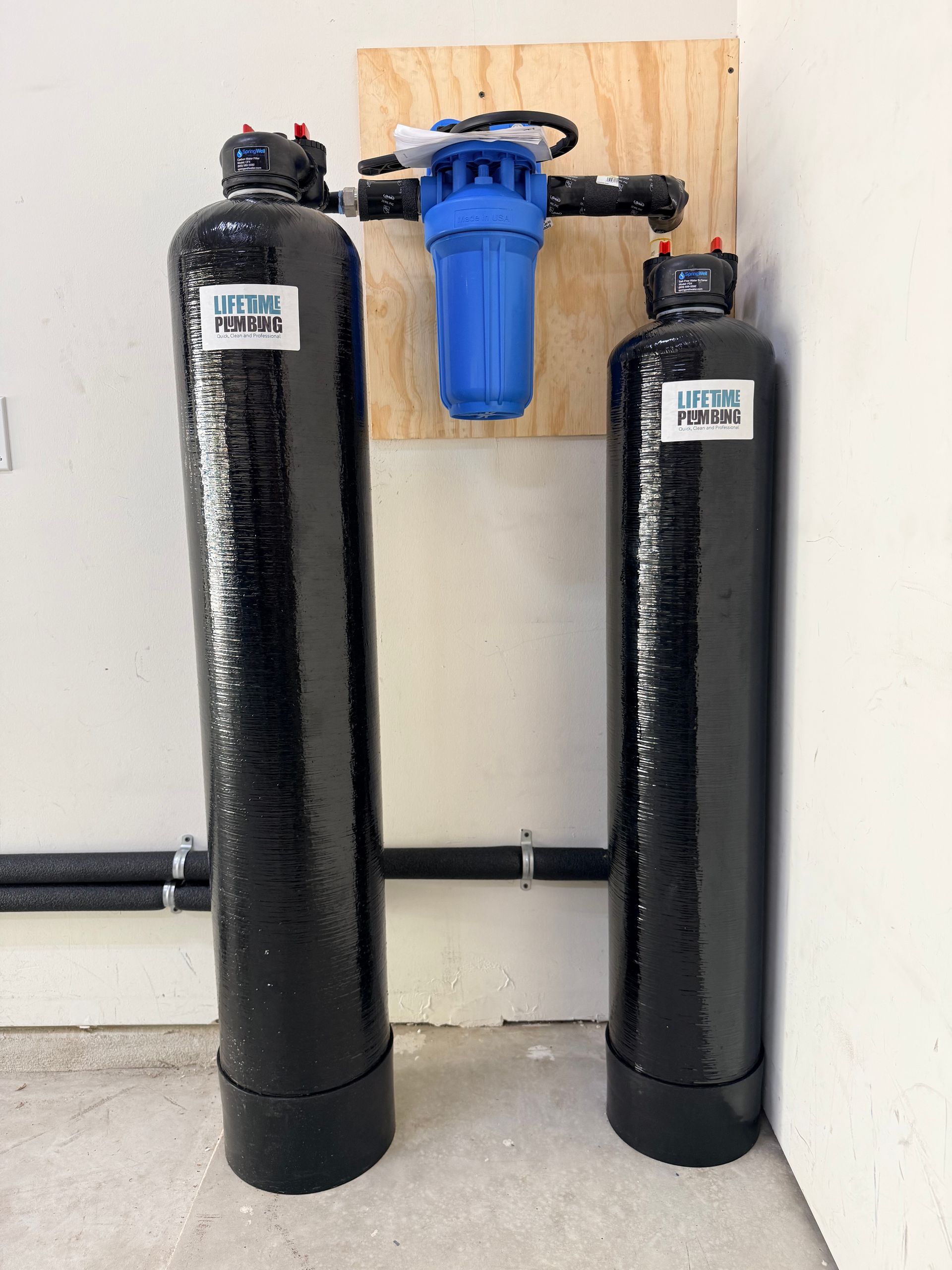
Water softener installation involves selecting a unit sized to match the household's daily water usage and the measured hardness level of the incoming supply. An undersized softener regenerates too frequently without fully treating the water volume passing through; an oversized unit regenerates too infrequently, allowing hardness minerals to break through between cycles. Installation includes connecting the softener to the main supply line before the water branches out to the rest of the house, setting up the brine tank with the correct salt type for the local water chemistry, and programming the regeneration schedule based on actual household demand rather than a factory default.
Request a service visit to have your water hardness assessed and get a recommendation on system sizing before any equipment is selected or purchased..
Why Hard Water Happens and How Softening Stops It
Ion exchange is the core mechanism in a water softener: resin beads inside the mineral tank carry a sodium charge that attracts and holds calcium and magnesium ions as water passes through, releasing sodium in their place. Over time the resin becomes saturated with hardness minerals and must be flushed with a brine solution—this is the regeneration cycle—to recharge the resin and push the captured minerals down the drain. When a softener stops performing, the problem is almost always one of a few things: salt bridges in the brine tank that prevent the brine from dissolving properly, a control valve that's not triggering regeneration on schedule, or resin that's been fouled by iron in the water supply and needs cleaning or replacement.
After a properly functioning softener is installed, scale stops forming on showerheads and fixture surfaces, soap lathers more readily with less product, and laundry comes out softer without the stiff texture that hard water leaves in fabric fibers. Fixtures and appliances that were already scaling gradually show improvement as softened water passes through—full clearing of existing buildup inside pipes and appliances depends on water temperature, flow rate, and how long the buildup had been accumulating before treatment began.
Lifetime Plumbing also handles routine water softener maintenance, which includes checking salt levels, inspecting the brine draw line for clogs, and verifying that the control valve is initiating regeneration correctly. For homeowners who have been putting off softener installation because of upfront cost, financing is available starting at twenty-two dollars per month—given how much Houston's hard water shortens fixture and appliance life, the long-term cost comparison between treating the water and replacing damaged fixtures early is worth reviewing before deciding.
Questions Before Starting Your Water Softener Project
These questions reflect what Houston homeowners most commonly want to understand before committing to water softener installation or repair.
- How is the right softener size determined for my home? System sizing is based on two numbers: your household's daily water consumption in gallons and your water's measured hardness level in grains per gallon—multiplying these gives the daily grain removal requirement, which determines the resin tank capacity needed to regenerate efficiently without allowing hardness breakthrough.
- What type of salt works best in Houston's water conditions? Because Houston's water supply frequently carries detectable iron levels alongside calcium and magnesium, iron-fighting salt formulas or resin cleaners added during regeneration help prevent the resin bed from fouling, which extends the effective service life of the resin without requiring premature replacement.
- Why does my existing softener seem to be using more salt than before? Increased salt consumption usually points to a control valve that's triggering regeneration too frequently due to a misconfigured timer, a brine tank float that's allowing overfilling, or a resin bed that's lost capacity and is compensating by regenerating more often.
- When should a water softener be replaced rather than repaired? Repair is the right call when the issue is limited to a control valve component, a salt bridge, or a fouled resin that can be cleaned—replacement makes more sense when the resin tank itself is cracked, the control valve is no longer available as a serviceable part, or the system is sized incorrectly for the household's actual water use.
- How does softened water affect skin and hair compared to hard water? Hard water minerals interact with soap to form a film that doesn't rinse completely from skin or hair, leaving a residue that many people describe as a tight or dry feeling after bathing—softened water allows soap to rinse cleanly, which is the observable difference most households notice first after installation.
Lifetime Plumbing can measure your incoming water hardness and walk you through system options matched to your household's actual usage—schedule a consultation to start with an accurate assessment rather than a guess at what size will work.