
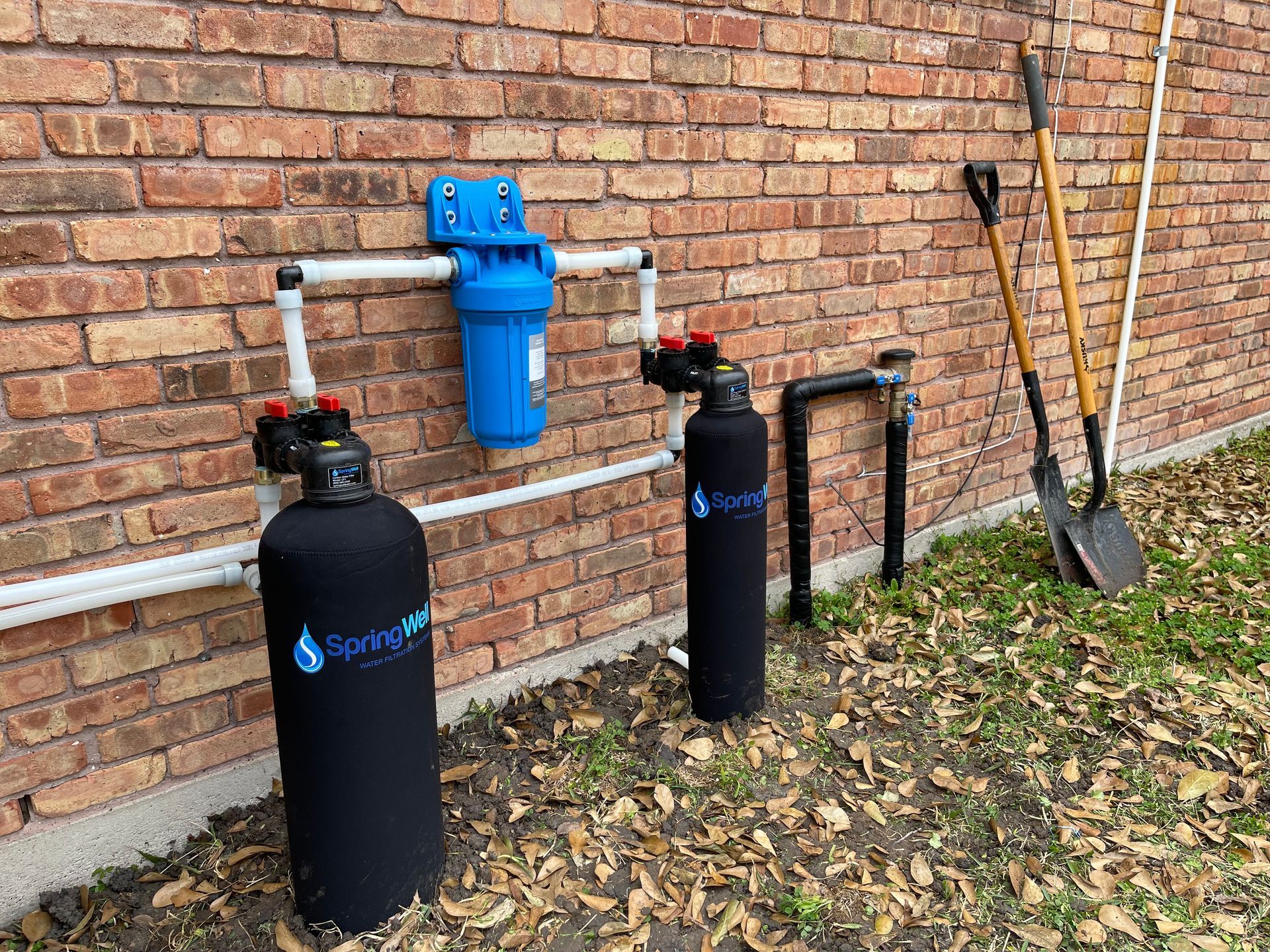
Filtered Water Running to Every Tap
Carbon Water Filter Installation in Houston for households dealing with chlorine taste, chemical odors, or water quality concerns affecting the whole house
Carbon filtration works by passing water through activated carbon media that adsorbs chlorine, chloramines, volatile organic compounds, and the organic byproducts that give tap water its characteristic chemical smell. Lifetime Plumbing installs carbon water filter systems in Houston at the whole-house level—meaning the filter treats all water entering the home before it branches to individual fixtures, rather than only addressing drinking water at a single tap. For Houston households, this distinction matters because the city's municipal water treatment relies heavily on chloramine disinfection, a compound that penetrates throughout the plumbing system and affects water quality at every point of use including showers, laundry, and cooking.
Whole-house carbon filter installation requires placing the filtration unit on the main supply line after the meter and before the water heater—this positioning ensures that both cold and hot water lines receive treated water. The carbon media housing is sized based on the home's flow rate demand; undersizing the filter causes pressure drop that affects shower performance and appliance function. Installation also includes setting up bypass valves so the system can be serviced or filters replaced without shutting water off to the entire house.
Set up a visit to review your main supply line configuration and determine the correct filter sizing for your home's flow requirements..
What Carbon Filtration Addresses Compared to Other Systems
Activated carbon media removes contaminants through adsorption—a surface bonding process where dissolved compounds attach to the porous carbon surface as water flows through. This is mechanically different from how a sediment filter works (physical straining) and how a reverse osmosis membrane works (pressure-driven exclusion). Carbon filtration is highly effective at removing chlorine, chloramines, taste compounds, odor-causing organics, and certain pesticide residues, but it does not remove dissolved minerals, heavy metals, or biological contaminants—understanding what the filter actually does guides the decision about whether carbon filtration alone addresses the household's water quality situation or whether it's best paired with additional treatment.
After whole-house carbon filtration is installed, the chlorine smell that normally rises from a hot shower dissipates, water used for cooking no longer carries the flat chemical taste that affects food and beverage flavor, and laundry washed in treated water doesn't retain the chloramine residue that can affect fabric over repeated wash cycles. These changes are noticeable within the first days of use and consistent across every fixture in the house—not limited to a single filtered tap.
Lifetime Plumbing handles carbon filter replacement when media is spent and routine maintenance to keep the system flowing at full capacity. Carbon media has a finite adsorption capacity that depletes over time based on water volume processed and the concentration of compounds being removed—in Houston, where chloramine levels in municipal water are maintained at relatively consistent concentrations, replacement intervals can be estimated based on household size and daily water consumption rather than waiting for taste or odor to return as the indicator. Emergency carbon filter services are also available when a system develops a leak, loses pressure, or stops performing between scheduled maintenance visits..
What Property Owners Usually Ask About Carbon Filtration
The following questions address the practical details that come up most often when Houston homeowners are evaluating whole-house carbon filter installation.
- How is a whole-house carbon filter different from an under-sink carbon filter? An under-sink unit treats only the water at one faucet, while a whole-house system filters all water entering the home—the difference shows up in shower water, laundry water, and every other fixture rather than just at the kitchen tap where the point-of-use filter is installed.
- Why does carbon media need to be replaced on a schedule rather than when problems appear? Activated carbon loses adsorption capacity gradually as binding sites fill up—by the time taste or odor returns to the water, the media has already been operating at reduced efficiency for some period, meaning replacement based on volume processed is more accurate than waiting for a noticeable change.
- What causes pressure drop after a whole-house filter is installed? Pressure drop almost always points to a housing that's undersized for the home's peak flow demand, a filter cartridge that's loaded with sediment and restricting flow, or a bypass valve that wasn't fully opened after installation—each has a straightforward fix once the cause is confirmed.
- How does Houston's use of chloramines affect carbon filter performance compared to chlorine? Chloramines are more chemically stable than free chlorine and require longer contact time with the carbon media to adsorb effectively—this means filter housing length and flow rate matter more in chloramine-treated water systems, and catalytic carbon media is often a better choice than standard activated carbon for Houston installations.
- What maintenance does a whole-house carbon system require beyond filter replacement? Periodic inspection of the housing O-rings, the inlet and outlet connections, and the bypass valve operation keeps the system from developing slow leaks at connection points—these checks take only a few minutes during a scheduled filter replacement visit.
Lifetime Plumbing can evaluate your main supply line and recommend a carbon filtration system matched to your home's flow rate and Houston's specific water treatment profile—contact the office to schedule your installation assessment and discuss system options.